


Office to residential: conversion with modular construction
Pacarada Modular Building Systems, Kelkheim (Taunus), Germany · Last updated: October 2026
Vacant office buildings can become homes. This saves land, keeps the structure and is often faster than demolition and new construction. Modular construction helps in three places: with prefabricated bathroom modules inside the existing building, with extensions and with added storeys.
Why conversion is in demand
In many cities office space stands empty while homes are missing. Office buildings are often centrally located, connected to roads, utilities and public transport, and have a sound skeleton of columns and floor slabs. Converting instead of demolishing uses what is already there: a large share of the embodied energy of a building is in its structure.
What is checked before the conversion
| Topic | Question |
|---|---|
| Structure | What loads can columns, floors and foundations take, including added storeys and new bathrooms? |
| Building depth and daylight | Can apartments be arranged so that all habitable rooms have windows? |
| Room height and grid | Do apartment layouts fit the column grid? Is there enough height for new floor build-ups and services? |
| Fire protection | Do the building class, escape routes and the requirements for party walls and floors change? |
| Sound insulation | Do floors and new party walls reach the values required for apartments under DIN 4109? |
| Building services | Where do the risers for bathrooms and kitchens run? Which heating and ventilation are possible? |
| Hazardous materials | Are there contaminants in the existing building that must be removed before the conversion? |
| Planning law | Is residential use permitted at the location? The change of use needs a building permit. |
What modular construction contributes
- Bathroom modules: finished bathrooms from the factory are brought into the existing building and connected. This shortens the fit-out and ensures consistent quality.
- Extension: where floor area is missing, or stairs, lifts and balconies are needed, prefabricated components are added.
- Added storeys: additional lightweight storeys create more living space on the same plot. More on this in the article Adding storeys and extensions with modular construction.
- Short construction time: factory production and the work in the existing building run in parallel.
- Fitting the existing building: in the Pacarada system, columns and beams (1D), wall and floor elements (2D) and room modules (3D) can be combined. The new parts follow the grid of the existing building.
Darmstadt example: 197 homes in a former office building
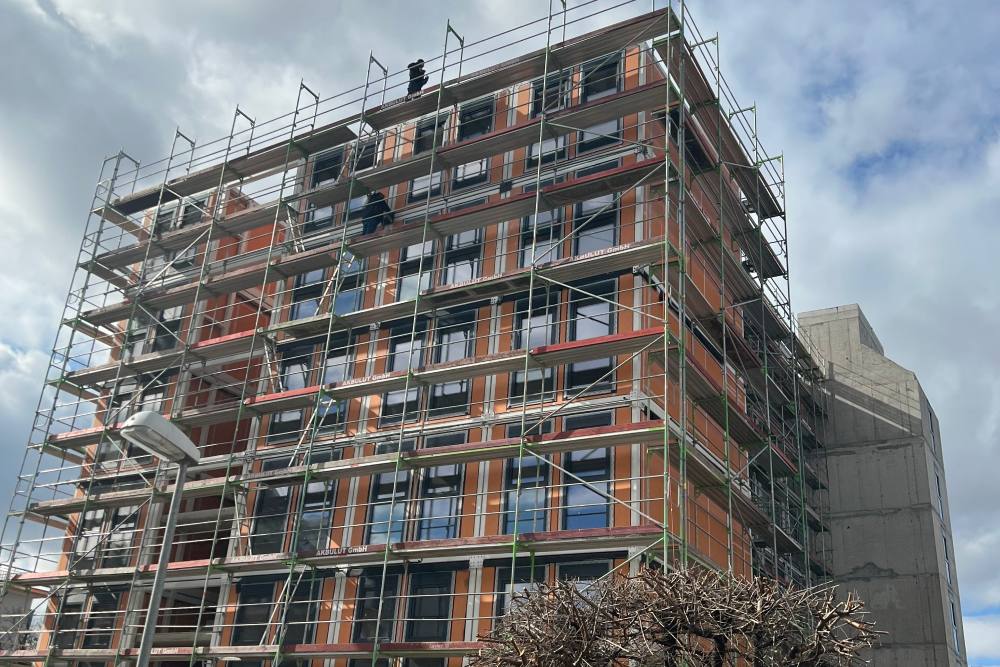
In Darmstadt, Germany, a vacant office building was converted into 197 homes, with bathroom modules inside the existing building, an extension and added storeys.
| Key figure | Value |
|---|---|
| Location | Darmstadt |
| Before | vacant office building |
| After | 197 homes |
| Measures | bathroom modules in the existing building, extension, added storeys |
| Construction time | 18 months (09/2021 to 02/2023) |
| Time advantage | 44% faster than conventional construction |
| Energy standard | KfW 55 |
Planning law in Germany: change of use and the acceleration law
Turning offices into homes is a change of use and needs a building permit. The authority checks whether residential use is permitted at the location under planning law and whether the building meets the requirements for apartments. Since 30 October 2025, section 246e of the Federal Building Code (the “Bau-Turbo”) has made such projects easier: with the consent of the municipality, deviations from planning law are possible until the end of 2030, expressly including the conversion of existing buildings into housing and added storeys. More on this in the article Building permits for modular buildings in Germany.
Funding
If the conversion reaches an efficiency house standard, federal promotional loans may be available. The article Funding for modular buildings in Germany gives an overview.
Frequently asked questions
Is converting offices into homes worthwhile?
It depends on the building: on structure, building depth, room height, fire protection and planning law. If the existing building is suitable, conversion saves the structure, time and land. An assessment of the existing building therefore always comes first.
Does the change of use need a building permit?
Yes. In Germany, changing from office to residential use is a change of use that requires a permit. Since October 2025 the municipality can consent to deviations from planning law under section 246e of the Federal Building Code, limited until the end of 2030.
How long does such a conversion take?
It depends on the size and condition of the building. In Darmstadt the conversion into 197 homes with an extension and added storeys took 18 months, which was 44% faster than conventional construction.
More articles in the modular building guide
- Modular or conventional construction? A comparison
- Adding storeys and extensions with modular construction
- Modular schools and nurseries
- Steel modular and hybrid construction: steel, timber and concrete combined
- What drives the cost of modular construction
- Serial and modular construction: terms and differences
- Building permits for modular buildings in Germany and type approval
- Fire protection and sound insulation in steel modular construction
- Funding for modular buildings in Germany: KfW, QNG and state programmes
- Back to the overview: modular building guide
Planning a project? Send us your enquiry, ideally with drawings. You will find all system data on our Facts and figures page.