


Fire protection and sound insulation in steel modular construction
Pacarada Modular Building Systems, Kelkheim (Taunus), Germany · Last updated: October 2026
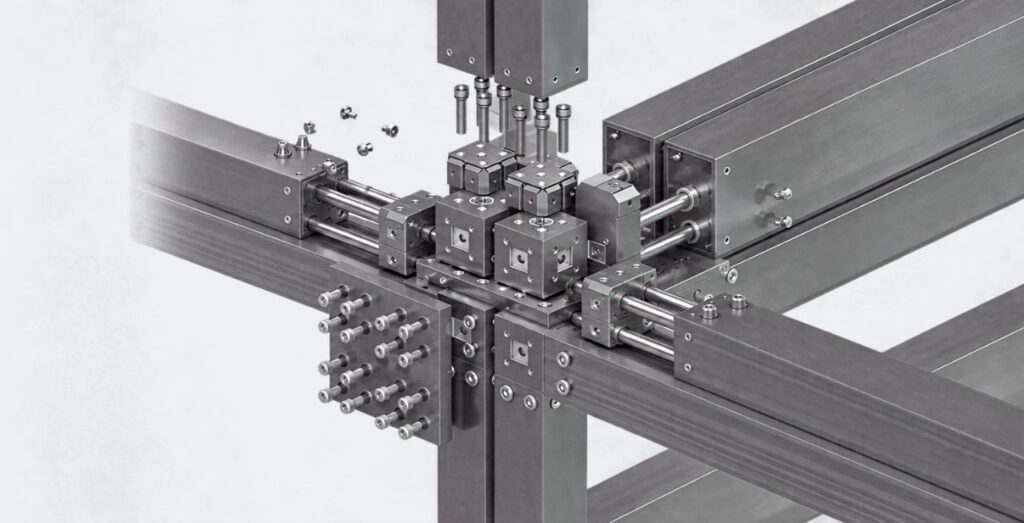
A modular building must meet the same requirements for fire protection and sound insulation as any other building. They are met with tested component build-ups that are produced in the factory under constant conditions. The key is the design of the joints and connections between the modules.
What the building code requires: building classes
In Germany, fire protection requirements depend on the building class. The model building code defines five classes, mainly by height. What counts is the height of the floor of the top storey with habitable rooms above ground level.
| Building class | Height | Load-bearing components, as a rule |
|---|---|---|
| 1 | up to 7 m, detached, no more than two units | no requirement in the storeys above ground |
| 2 and 3 | up to 7 m | fire-retardant (30 minutes) |
| 4 | up to 13 m | highly fire-retardant (60 minutes) |
| 5 | over 13 m | fire-resistant (90 minutes) |
| High-rise (special building) | over 22 m | fire-resistant, plus the rules for high-rise buildings |
The building code of the respective federal state is binding. Additional regulations apply to special buildings such as schools, hospitals, hotels, places of assembly and high-rise buildings, and a fire protection concept is required.
Steel in a fire
Steel does not burn and does not add to the fire load. At high temperatures, however, it loses strength. Load-bearing steel components are therefore protected as required:
- Cladding with fire protection boards, for example gypsum fibre or calcium silicate.
- Intumescent coating that foams up in a fire and insulates the steel.
- Composite with concrete that encases or fills the steel.
- Design by calculation for the fire situation under Eurocode 3 (EN 1993-1-2).
In the Pacarada Modular Building System steel can be combined with timber and concrete. Steel and concrete is chosen, among other reasons, when fire protection and sound insulation call for it. More on this in the article Steel modular and hybrid construction.
What matters in modular construction
- Joints and cavities: joints and cavities form between room modules. They are sealed so that fire and smoke cannot spread from module to module.
- Penetrations: services that pass through fire-rated walls and floors are given tested fire stops. In the factory they can be installed and documented under controlled conditions.
- Escape routes: stair cores and corridors are designed as in any building. The Pacarada system includes stair and lift modules.
- Verification: wall and floor build-ups need proof of usability, such as test certificates or approvals.
Sound insulation: what is required
In Germany the minimum requirements for sound insulation are set by DIN 4109. It applies between separate apartments and units, not within your own apartment. For apartment buildings the standard requires:
| Component | Requirement under DIN 4109-1 | Protects against |
|---|---|---|
| Party wall between apartments | sound reduction index R′w of at least 53 dB | airborne sound, such as speech and music |
| Floor between apartments | sound reduction index R′w of at least 54 dB | airborne sound between storeys |
| Floor between apartments | impact sound level L′n,w of no more than 50 dB | impact sound, such as footsteps |
Clients who want more quiet agree on enhanced sound insulation, for example under DIN 4109-5 or VDI 4100. This should be stated explicitly in the contract.
Why modules have an advantage in sound insulation
Room modules bring a property that helps sound insulation: each module has its own walls, its own floor and its own ceiling. Between two apartments there are therefore two walls with a gap between them, and between two storeys the ceiling and the floor lie separately on top of each other. This double-leaf construction insulates airborne sound well, provided the two leaves are kept consistently separate.
Lightweight construction needs care with low frequencies and impact sound. Floating screeds or dry screeds, elastic bearings between the modules and decoupled suspended ceilings have proved effective. Which build-up is chosen depends on the use: a hotel, a student residence or a hospital has different target values than an office building.
Frequently asked questions
Does a steel modular building meet fire protection requirements?
Yes. It must meet the same requirements as any other building of its building class. Steel does not burn, but it loses strength at high temperatures. Load-bearing steel components are therefore clad, coated or combined with concrete as required.
How high can you build with modules?
Building law sets no separate limit for modular buildings. Requirements rise with height: in Germany, above 13 m (building class 5) load-bearing components must be fire-resistant, and above 22 m the rules for high-rise buildings apply. The Pacarada Modular Building System is designed for buildings from 1 to 50+ storeys.
Are modular buildings noisy?
Not if they are designed properly. Room modules have their own walls, floors and ceilings. Between two apartments this creates a double-leaf separation that insulates airborne sound well. Screed, elastic bearings and decoupled ceilings deal with impact sound. In Germany the minimum values are set by DIN 4109.
More articles in the modular building guide
- Modular or conventional construction? A comparison
- Adding storeys and extensions with modular construction
- Modular schools and nurseries
- Steel modular and hybrid construction: steel, timber and concrete combined
- What drives the cost of modular construction
- Serial and modular construction: terms and differences
- Building permits for modular buildings in Germany and type approval
- Office to residential: conversion with modular construction
- Funding for modular buildings in Germany: KfW, QNG and state programmes
- Back to the overview: modular building guide
Planning a project? Send us your enquiry, ideally with drawings. You will find all system data on our Facts and figures page.